Words Their Way PDF: A Comprehensive Article Plan
Words Their Way’s popularity stems from its developmental methods, offering hands-on phonics, vocabulary, and spelling instruction – readily available as PDF resources.
Words Their Way has emerged as a cornerstone resource for educators seeking a dynamic and research-backed approach to literacy instruction. This program, authored by Donald R. Bear, Marcia R. Invernizzi, and Shane Templeton, isn’t simply a spelling program; it’s a comprehensive word study system designed to unlock a student’s full potential in reading and writing.
At its heart, Words Their Way recognizes that students progress through predictable developmental stages in their understanding of word patterns. The program provides a framework for teachers to meet students where they are, offering targeted instruction that builds upon existing knowledge. The availability of PDF resources further enhances accessibility and implementation for busy educators. It’s a hands-on method, emphasizing active learning through sorting activities and exploration.
This introduction will delve into the core principles, developmental stages, and practical applications of Words Their Way, highlighting its impact on literacy development and exploring available resources.
What is Words Their Way?

Words Their Way is a developmentally-driven approach to word study, fundamentally changing how educators teach phonics, spelling, and vocabulary. It moves beyond rote memorization, instead focusing on helping students understand the why behind word patterns. The program’s core lies in its hands-on activities, particularly sorting, which allows students to actively discover and internalize spelling principles.
Unlike traditional programs, Words Their Way doesn’t follow a rigid, grade-level curriculum. Instead, it utilizes assessments to determine each student’s current stage of word knowledge. This allows for differentiated instruction, ensuring that every learner is challenged appropriately. Many resources, including PDF guides, support this individualized approach.
Essentially, it’s a system that integrates reading and spelling, recognizing their reciprocal relationship – improvements in one area naturally benefit the other. It’s a powerful tool for building a strong foundation in literacy.
The Core Principles of the Program

Words Their Way operates on several key principles. First, it’s developmental, meaning instruction aligns with students’ evolving understanding of word patterns. Second, it’s explicit and systematic, providing clear teaching and a logical progression of skills. Third, it’s multisensory, engaging students through visual, auditory, and kinesthetic activities – often utilizing manipulatives during sorting.
A central tenet is the idea that spelling and reading are reciprocal; strengthening one enhances the other. The program emphasizes analyzing words to uncover patterns, rather than simply memorizing spellings. Access to PDF resources aids in implementing these principles effectively.
Finally, differentiation is crucial. Recognizing that students progress at different rates, Words Their Way encourages teachers to tailor instruction to individual needs, fostering a supportive learning environment.
Developmental Stages in Words Their Way
Words Their Way outlines distinct developmental stages reflecting a student’s evolving word knowledge. These stages – Emergent, Early Letter Name-Alphabetic, Late Letter Name-Alphabetic, Within Word Pattern, Syllable Juncture, and Morphology – aren’t age-dependent, but rather represent qualitative shifts in understanding.
Initially, the Emergent stage focuses on letter recognition. Progressing, students move through the Letter Name-Alphabetic stages, grasping consonant-vowel patterns. The Within Word Pattern stage involves mastering long vowel patterns and common spelling rules. Later stages address multisyllabic words (Syllable Juncture) and morphemes (Morphology).
PDF resources often categorize activities by these stages, allowing teachers to pinpoint appropriate instruction. Understanding these stages is vital for effective differentiation and targeted support.
Emergent Stage (Letter Name-Alphabetic Stage)
The Words Their Way Emergent Stage, often overlapping with the early Letter Name-Alphabetic phase, centers on foundational skills. Students begin connecting letters to sounds, primarily focusing on beginning consonants and short vowel sounds. PDF materials for this stage emphasize pre-letter writing activities and initial sound sorting.
Activities involve manipulating letter tiles to build simple CVC (consonant-vowel-consonant) words like “cat” or “sun.” The goal isn’t perfect spelling, but rather phonetic awareness. Teachers utilize picture sorts, prompting students to group images based on shared beginning sounds.
PDF resources provide templates for these sorts and offer guidance on scaffolding instruction. This stage builds the crucial link between graphemes and phonemes, setting the stage for more complex word study.
Early Letter Name-Alphabetic Stage
In the Words Their Way Early Letter Name-Alphabetic Stage, students expand upon their emergent skills, confidently identifying most consonant sounds and short vowel sounds. PDF resources at this level introduce blends and digraphs (like “bl,” “st,” “sh,” and “ch”), challenging students to recognize these patterns.
Sorting activities become more sophisticated, moving beyond initial sounds to include medial vowels and ending consonants. Students begin attempting to spell simple words independently, applying their phonetic knowledge. Teachers provide targeted feedback, focusing on sound-letter correspondence.
PDF materials offer word lists, picture cards, and sorting templates designed to reinforce these concepts. The emphasis remains on phonetic awareness and building a strong foundation for decoding and encoding skills.
Late Letter Name-Alphabetic Stage
The Words Their Way Late Letter Name-Alphabetic Stage marks a significant leap in students’ word study journey. PDF resources now focus on long vowel sounds, introducing silent ‘e’ patterns and vowel teams (like “ai,” “ee,” and “oa”). Students begin to grapple with more complex phonetic relationships.
Sorting activities challenge students to differentiate between short and long vowel sounds, and to identify common spelling patterns. Independent spelling becomes more accurate, though errors related to vowel sounds are still common. Teachers continue to provide focused instruction and feedback.
PDF materials at this stage include more challenging word lists, picture sorts, and writing prompts; The goal is to solidify students’ understanding of vowel patterns and prepare them for the next stage of word study.
Within Word Pattern Stage
The Words Their Way Within Word Pattern Stage, supported by comprehensive PDF resources, signifies a shift towards analyzing word structures. Students move beyond simple phonetic elements and begin to recognize patterns within syllables. Common vowel patterns, like CVCe (consonant-vowel-consonant-e) and vowel digraphs, become central to their study.
Sorting activities now emphasize identifying these patterns and applying them to both reading and spelling. Students explore how changing a single vowel can alter a word’s meaning. PDF materials offer increasingly complex word lists and encourage students to generate their own examples.
This stage fosters a deeper understanding of how spelling and meaning are connected, building a strong foundation for more advanced word study concepts. Accurate spelling improves as students internalize these patterns.
Syllable Juncture Stage
The Words Their Way Syllable Juncture Stage, detailed in accessible PDF guides, focuses on understanding how syllables combine in multi-syllabic words. Students move beyond single-syllable analysis, learning to identify syllable types – closed, open, vowel-consonant-e, vowel teams, and r-controlled – and how they influence pronunciation and spelling.
Sorting activities now involve breaking down words into their constituent syllables and recognizing patterns at the junctures. Emphasis is placed on understanding affixes (prefixes and suffixes) and their impact on word meaning. PDF resources provide lists of words categorized by syllable patterns.
This stage builds crucial skills for decoding longer, more complex words, enhancing both reading fluency and spelling accuracy. Students begin to apply this knowledge to unfamiliar vocabulary.
Morphology Stage
The Words Their Way Morphology Stage, comprehensively covered in available PDF materials, represents the highest level of word study. Students delve into the meaning of morphemes – the smallest units of meaning in the English language – including prefixes, suffixes, and root words.
Sorting activities at this stage focus on identifying and categorizing morphemes, understanding how they alter a word’s meaning, and applying this knowledge to decode unfamiliar words. PDF resources offer extensive lists of base words and affixes.
This stage fosters a deeper understanding of vocabulary and etymology, empowering students to independently analyze and interpret complex words. It’s a critical step towards advanced literacy skills.
Key Components of Words Their Way Instruction
Words Their Way instruction, detailed in accessible PDF guides, centers around a cyclical process. It begins with sorting – hands-on activities where students categorize words based on spelling patterns. These patterns directly link to phonics, spelling, and vocabulary development.
Explicit instruction clarifies the rationale behind the sorting rules, connecting them to broader linguistic principles. Regular word hunts encourage students to actively seek out examples of the target patterns in authentic texts.
PDF resources provide teachers with detailed lesson plans and assessment tools. The program emphasizes differentiation, adapting to individual student needs. This integrated approach, readily available in PDF format, fosters a robust understanding of word knowledge.
Sorting Activities: The Heart of the Method
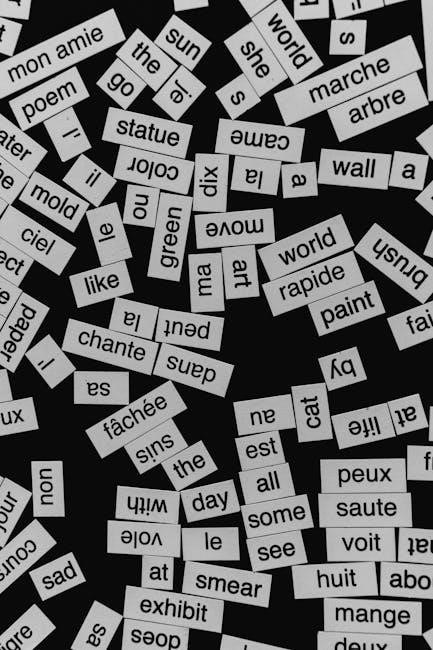
At the core of Words Their Way, easily accessed through PDF materials, lie the sorting activities. These aren’t merely exercises; they are the engine driving word study. Students manipulate words, grouping them based on shared features – vowel patterns, consonant blends, or morphological elements.
PDF guides detail various sorting types: picture sorts for emergent learners, word sorts focusing on sounds, and feature sorts highlighting specific spelling patterns. These activities are designed to be interactive and engaging, fostering active learning.
The power of sorting, as outlined in Words Their Way PDF resources, lies in its ability to make abstract concepts concrete. Students discover patterns independently, building a deeper understanding of how words work.
Integrating Phonics, Spelling, and Vocabulary
Words Their Way, comprehensively detailed in its PDF format, champions a unified approach to literacy, seamlessly integrating phonics, spelling, and vocabulary development. It rejects the notion of teaching these skills in isolation, recognizing their reciprocal relationship.
The program’s PDF resources demonstrate how understanding spelling patterns reinforces phonics skills, while a robust vocabulary enhances both reading comprehension and accurate spelling. Activities encourage students to explore connections between sounds, letters, and meanings.
Through targeted word sorts and feature analysis – readily available in Words Their Way PDF guides – students learn that what they discover in spelling directly impacts their reading, and vice versa, fostering a holistic literacy experience.
The Role of Word Study in Literacy Development
Words Their Way, as outlined in its detailed PDF materials, positions word study as central to overall literacy development, moving beyond rote memorization to foster a deep understanding of word patterns. The program’s PDF guides emphasize that effective reading and writing hinge on a strong foundation in word knowledge.

By systematically exploring phonics, spelling, and vocabulary, students develop the ability to decode unfamiliar words, improve spelling accuracy, and expand their expressive language skills. The Words Their Way PDF resources provide educators with tools to cultivate independent word learners.
This approach, detailed within the PDF, empowers students to analyze words, identify patterns, and apply their knowledge to both reading and writing tasks, ultimately enhancing their overall literacy proficiency.
Benefits of Using a Developmental Approach
The Words Their Way PDF materials champion a developmental approach to word study, recognizing that students progress through distinct stages of word knowledge. This method, detailed in the PDF guides, allows instruction to be tailored to each student’s current level, maximizing learning potential.
Unlike one-size-fits-all programs, the Words Their Way PDF supports differentiated instruction, ensuring that students are challenged appropriately. This fosters engagement and builds confidence as they master skills at their own pace. The PDF resources highlight how this approach improves responsiveness.
By aligning instruction with students’ developmental needs, Words Their Way, as presented in its PDF format, creates a more efficient and effective learning experience, leading to significant gains in literacy skills.
Words Their Way PDF Resources: Availability and Access
Numerous Words Their Way PDF resources are readily available online, offering educators convenient access to materials for implementation. These PDFs often include activity sheets, sorting cards, and detailed lesson plans, supporting the program’s hands-on approach. Many websites provide downloadable samples and previews of the full Words Their Way PDF curriculum.
Furthermore, educators can often find free PDF word study activities and resources online, supplementing the core program. Some platforms offer the option to receive these PDF materials directly to your inbox, streamlining lesson preparation. Accessing these PDF resources simplifies classroom integration.
While comprehensive versions may require purchase, the abundance of available Words Their Way PDF materials makes it a highly accessible program for teachers seeking effective word study solutions.
Free Resources and Activities Available Online
A wealth of complimentary Words Their Way-aligned resources and activities are accessible online, bolstering classroom instruction without additional cost. Educators can discover free PDF word study activities, sorting lists, and printable game templates designed to reinforce key concepts. These resources often focus on specific developmental stages, like the Letter Name-Alphabetic Stage, offering targeted practice.
Websites dedicated to literacy instruction frequently host free downloadable materials, including sample sorting activities and word lists. Many teachers share their own created resources, fostering a collaborative learning environment. These free PDFs provide valuable supplementary materials.
Exploring online educational platforms and teacher blogs reveals a continuous stream of free Words Their Way-inspired activities, enhancing learning opportunities for students.

Implementing Words Their Way in the Classroom

Successfully implementing Words Their Way begins with a thorough assessment to determine each student’s developmental stage in word study. Utilizing the program’s diagnostic assessments, teachers can group students based on their spelling inventories, ensuring targeted instruction. The core of implementation revolves around sorting activities, often delivered in small groups.
Teachers should provide explicit instruction on the sorting concepts, modeling the process and guiding students through initial sorts. Regularly incorporating PDF-based word lists and activities enhances practice. Differentiation is key; adjust the complexity of sorts and activities to meet individual needs.
Consistent integration with reading and writing activities solidifies learning, making word study a dynamic component of literacy instruction.
Addressing Diverse Learner Needs
Words Their Way’s developmental approach inherently supports diverse learners, as instruction is tailored to individual stages, not grade level. For struggling spellers, provide pre-sort activities and simplified word lists, often found in readily available PDF resources. Extend learning for advanced students with challenge sorts and opportunities to create their own word patterns.
English Language Learners benefit from explicit phonics instruction and visual supports during sorting. Utilizing manipulatives and hands-on activities caters to kinesthetic learners. Students with dyslexia may require multi-sensory approaches and increased repetition.
Regular formative assessment, coupled with flexible grouping, ensures all students receive appropriate support and scaffolding throughout the word study process.
Comparing Words Their Way to Other Word Study Programs

Unlike some prescriptive programs, Words Their Way emphasizes a developmental, student-centered approach, adapting to individual needs – often accessible through convenient PDF guides. Programs like Spalding focus heavily on multi-sensory techniques, while others prioritize rule memorization. Words Their Way uniquely balances systematic phonics with authentic word exploration.

Compared to traditional spelling lists, it fosters a deeper understanding of word patterns. While programs like Houghton Mifflin Harcourt’s Journeys integrate word study within a broader literacy curriculum, Words Their Way offers a dedicated, in-depth focus.
Its strength lies in its flexibility and ability to be implemented alongside existing curricula, providing targeted support where needed.
Criticisms and Limitations of the Program
Despite its strengths, Words Their Way isn’t without limitations. Some educators find the initial setup and sorting activity preparation time-consuming, even with readily available PDF resources. The program’s effectiveness relies heavily on consistent, accurate teacher implementation and understanding of the developmental stages.
Critics suggest that the open-ended nature of some activities may not suit all learners, particularly those needing more explicit instruction. Furthermore, while the program addresses phonics, spelling, and vocabulary, it doesn’t comprehensively cover all aspects of literacy, like reading comprehension strategies.
Accessibility of supplemental materials and professional development can also be a barrier for some schools.
Future Trends in Word Study and Words Their Way
The future of word study, including approaches like Words Their Way, likely involves increased integration with technology and personalized learning platforms. Expect to see more digital PDF resources, interactive sorting activities, and adaptive learning components tailored to individual student needs.

Research continues to emphasize the importance of explicit and systematic phonics instruction, potentially influencing future editions of the program. A growing focus on morphology and etymology – the origins and structures of words – may also be incorporated more deeply.
Furthermore, bridging the gap between word study and broader literacy skills, such as reading comprehension and writing, will be crucial. Accessibility and culturally responsive pedagogy will remain key considerations in evolving word study practices.